

Listen Up
Explore a curated collection of audio moments—from interviews to soundscapes—designed to inform, inspire, and engage. Whether you're here to learn, reflect, or just enjoy, our audio selections offer something for every listener.

The Unfiltered Loop, Part 4 of 5: The Heat That Breaks the Molecule
Stop calling it PFAS. The lab-coat word keeps you numb.
It's forever chemistry — synthetic, indestructible, built like armor — and it's already inside you. In your blood. It was in your mother's blood when she carried you. It'll be in your grandchildren's.
We've lived with it so long, we don't recognize it as a killer when we eat it.
Part 4 of The Unfiltered Loop: The Heat That Breaks the Molecule. Filters move it. Laws manage tomorrow. Only heat ends it.
Filters move it. Laws manage tomorrow. Only heat ends it.
Part 3 ended with the wound no law can heal: the sludge already in the ground, the wells already hot. Maine's ban stops the next farm from dying. California's product bans choke off the next generation of contamination. Neither one touches a single molecule already out there.
But before the chemistry, the dread — because this series hasn't named it yet.
Stop calling it PFAS for a minute. The lab-coat word keeps you numb. What it is, in the language your body understands, is forever chemistry — synthetic, indestructible, built like armor — and it's already inside you. In your blood. It was in your mother's blood when she carried you. It will be in your grandchildren's blood. The body has no way to get rid of it. Not might get in. In. Forever.
We've been living with it so long — the pan, the jacket, the wrapper, the water, so far into our lives — that we do not recognize it as a killer when we eat it.
And here's the part that should chill you: we put it there ourselves. We manufactured our own infection, and called the symptoms convenience.
So let's talk about the molecule.
The bond that won't break
PFAS are called forever chemicals for one reason: the carbon-fluorine bond. It is among the strongest bonds in all of chemistry. Nothing in nature breaks it — not sunlight, not microbes, not time. A treatment plant can't digest it. A filter can't unmake it. A statute can't repeal it. That bond is the whole problem, and everything we've tried so far has tiptoed around it.
Look at the record. Twin Falls installs filtration: the bond survives, relocated into spent filter media. Mountain Home spends $126 million walking away from its groundwater: the bond survives, sitting in an aquifer nobody drinks from anymore. Idaho spreads its bio waste on farmland without testing for a single PFAS compound: the bond survives, riding from flush to fork. The EPA studies two compounds out of thousands: the bond survives, unregulated.
We have never destroyed PFAS. We have only moved it — from water to filter, from aquifer to pipeline, from treatment plant to field to cow to milk to blood. Every "solution" so far is a relocation program with better paperwork.
The one thing that works
There is exactly one force that breaks the carbon-fluorine bond: heat. Enough of it, applied right — sustained conversion at 700°C and up, with the off-gas captured and scrubbed — and the molecule doesn't get smaller or safer, it ceases to exist. Defluorination takes place: fluorine locked into inert mineral salts, carbon into biochar. Chemists call it mineralization. Plain English: the poison dies.
This is pyrolysis — high-temperature conversion in the absence of oxygen. Not burning, which is sloppy and makes its own mess. Pyrolysis is controlled: feed the waste in, hold the heat, and what comes out the other side is not a concentrated poison but biochar — stable carbon that rebuilds soil instead of poisoning it.
Understand what that means for every dead end in this series. The spent filter media piling up at Twin Falls? Feedstock. The bio waste Idaho spreads untested on farmland? Feedstock. The sludge California still land-applies — forty million pounds a day — while its left hand bans the chemical? Feedstock. Everything we've been paying to move, bury, or walk away from becomes the raw material of the machine that ends it.
Sunlight doing the killing
Here's the turn that makes it more than an engineering curiosity: the heat doesn't have to come from fossil fuel. Stationary solar-thermal arrays can drive co-pyrolysis — concentrated sunlight supplying the process heat, no smokestack, no fuel bill, no irony of burning carbon to kill carbon. Concentrated solar carries the primary heat load; thermal storage and the syngas the process itself produces carry it through the night. A furnace that feeds itself, around the clock.
And "co" is doing real work in that word. One facility takes multiple waste streams at once: wildfire fuel pulled off overgrown ground, orchard waste, PFAS-laden bio waste, spent filter media. The woody biomass isn't filler — it adds the structural carbon and energy density that wet sludge alone can't sustain, which is what makes the thermal conversion complete. The same machine that mineralizes forever chemicals also converts the fuel load that burns our communities into biochar. One regional facility answers two existential problems — the fire coming over the ridge and the poison already in the well.
This is not a someday technology. Pyrolysis is proven; solar-thermal is proven. What's missing is the decision to build it — and the public demand that forces the decision.
Closing the loop
Go back to the cycle this series is named for: from flush to fork. Wastewater becomes bio waste. Right now the loop runs poisoned, because we spread the bio waste raw and the forever chemicals ride it all the way to the table.
Pyrolysis closes the loop the only way it can be closed: the poison dies in the middle. Wastewater becomes bio waste, bio waste goes through the heat, the PFAS is mineralized out of existence, and what reaches the farmland is clean biochar — carbon that holds water, holds nutrients, and holds nothing that will show up in a farmer's blood test ten years later. From flush to fork, with the killing done in between.
The money is already being spent
Nobody needs to find new money for this. The money is already on fire.
Mountain Home is spending over $126 million not to fix its PFAS problem but to dodge it — a pipeline and a treatment plant so the base can drink from somewhere else. Every filtration project in America is manufacturing tomorrow's disposal problem in the form of spent media. Every untested acre of spread bio waste is a future Stoneridge Farm, and Maine showed us what the cleanup bill looks like: $60 million for one small state's wreckage.
Destruction converts those liabilities into feedstock. The region is already paying nine figures to move PFAS around. A pyrolysis facility takes that same waste stream and ends it — and hands farmers back biochar instead of poison.
The choice was never between affording the solution and affording the problem. We're already affording the problem. We're just not getting anything for it.
Part 5: A regional infrastructure blueprint for Herald 95638 — where the facility goes, what it takes, and why the most fire-threatened ground in Sacramento County is the right place to prove the loop can close.
This is Part 4 of The Unfiltered Loop, a five-part investigation into PFAS, wastewater, and the sludge we spread on our food. Read the series from the beginning.
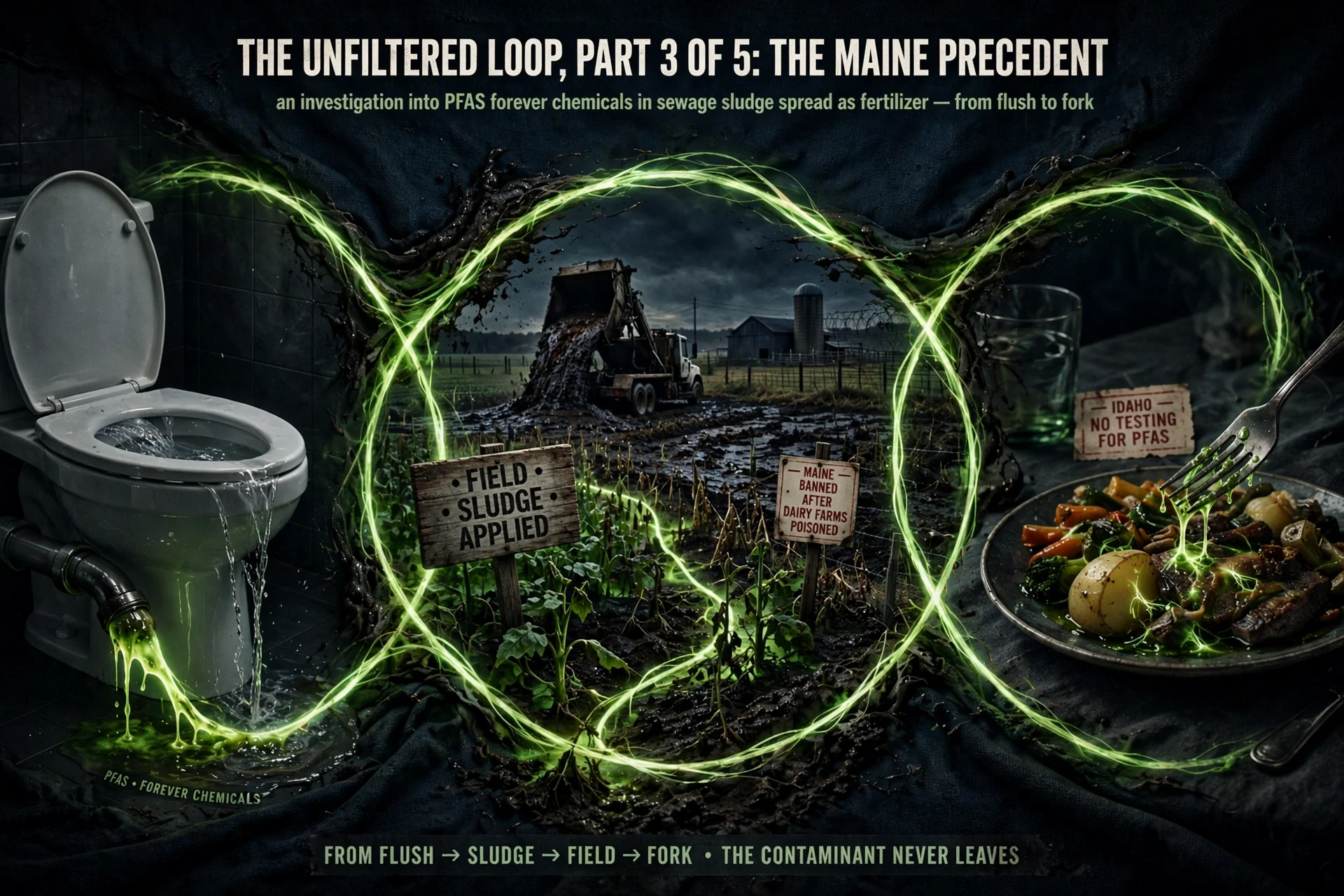
The Unfiltered Loop, Part 3 of 5: The Maine Precedent
Maine banned spreading sewage sludge after its dairy farms were poisoned. Idaho doesn't even test. From flush to fork — nobody is checking the cargo.
One state watched its farms die and did what no one else would. California is writing its own version — in pieces.
Fred Stone ran a dairy in Arundel, Maine. Multigenerational. The kind of farm that measures its life in decades and its wealth in healthy animals.
The state came to him with a deal. Free fertilizer. State-approved. Environmentally friendly. Truck it in, spread it on the fields, watch the grass grow. He did it for years.
Then the milk tested hot.
Per- and polyfluoroalkyl substances — the forever chemicals from Part 2 of this series — were in his cows, in his milk, in his blood. The "environmentally friendly" fertilizer had been poisoning his land the entire time. Stoneridge Farm shut down. A working dairy, killed not by markets or weather, but by a state program.
Maine's Department of Environmental Protection didn't merely allow sludge spreading. It distributed the sludge. It marketed the program as green. For decades, the state handed farmers toxin-laced waste and called it stewardship. This wasn't a loophole. It was policy.
Fred Stone wasn't alone. At Songbird Farm in Unity, Adam Nordell and Johanna Davis bought their dream farm in 2014 and discovered by 2021 that their soil, their water, and their own blood were loaded with PFAS — at levels that made national headlines. Farm after farm learned the hard way what the state had been slow to admit: the free fertilizer was the poison.
The Unfiltered Loop, Part 3 of 5: The Maine Precedent
The line
In May 2022, Maine did what no state had done. L.D. 1911 — carried by Rep. Bill Pluecker, himself a farmer — banned the land application of sewage sludge and sludge-derived compost. Governor Janet Mills signed it. First in the nation. Bipartisan.
And Maine didn't stop at the ban. L.D. 2013 set aside $60 million for the wreckage: income replacement for shuttered farmers, buybacks of poisoned farmland, medical monitoring for farmers and well owners, money for research into what can even grow on contaminated ground anymore.
Read that again. A state government looked at its own program, called it poison, shut it down, and paid for the damage. That is the precedent. Not the ban — the admission.
The stall
Maine drew the line. The rest of the country is still deciding whether to pick up the pen.
Other states are now weighing their own bans or tighter treatment rules. The EPA, meanwhile, keeps studying, promsing a risk assessment for two PFAS compounds, PFOA and PFOS, while thousands of others ride through treatment plants untouched. Kyla Bennett of Public Employees for Environmental Responsibility, who represents farmers suing the EPA to force regulation of PFAS in bio solids, put it plainly: farmers and ranchers and consumers are being injured now. Studying the fire while the house burns.
And there's the patchwork problem. PFAS doesn't respect state lines. A ban in Maine doesn't stop a single truck in California. In 2021, about 43 percent of all bio solids generated in the United States were land-applied. The machine is still running.
Idaho, right now
Maine is the past. Here's the present.
On September 29 — last week — the city of Twin Falls, Idaho, told residents that a drinking-water well at Magic Valley Regional Airport tested over the federal limit for PFAS: PFOA at 9.83 parts per trillion, PFOS at 5.35, against a limit of 4.0. Not the city's water — the airport's own well. They're installing filtration and chasing grants for a permanent fix.
Filtration. Read that word carefully, because it matters for where this series is going: a filter doesn't destroy PFAS. It catches it. The poison moves from the water into the filter media, and then the filter media becomes the problem — another waste stream, another thing to bury or burn. We are very good at moving PFAS around. We have no plan for ending it.
Thirty miles west sits Idaho's worst PFAS site: Mountain Home Air Force Base, poisoned by decades of firefighting foam. The base isn't cleaning its groundwater. It's abandoning it — a $32 million pipeline to pull water from the Snake River instead, plus a $100 million treatment plant due in 2027. Over $130 million spent". Over $126 million spent not to fix the poison, but to walk away from it.
And Idaho's biosolids program? The state requires management plans for land application and tests for exactly zero PFAS compounds. No testing requirement. No ban. No documented complaints — because nobody is looking. Maine banned the spread; Idaho doesn't even check what's in it. The cycle runs from flush to fork, and nobody is checking the cargo.
One honest footnote, because this series doesn't trade in claimed clusters: there is no documented cancer cluster under investigation in Idaho right now. Not one. The contamination is real and measured; the bodies haven't been counted yet. That's not reassurance. That's the lag — exposure first, epidemiology years later, if ever. Maine's farmers learned what that lag costs.
California's parallel war
California hasn't banned land application. But it is fighting the same enemy upstream — at the source, before PFAS ever reaches a treatment plant.
AB 1200 (2021) ripped PFAS out of plant-based food packaging starting January 2023. AB 1817 (2022) did the same to textiles and apparel starting January 2025, tightening the threshold to 50 parts per million in 2027 — your rain jacket, your couch, your kid's backpack. And AB 347 (2024) gave the whole apparatus teeth: the Department of Toxic Substances Control as lead enforcer, mandatory manufacturer registration, minimum $10,000 penalties per violation, full enforcement landing in 2030.
The logic is sound and it's the same logic Maine arrived at from the other direction: prevention is the only cure. Every pound of PFAS kept out of a product is a pound that never reaches wastewater, never rides sludge onto a field, never ends up in a farmer's blood.
What the laws can't do
Here is the blade every one of these laws carries: they all aim at tomorrow.
Maine's ban stops the next farm from dying. California's product bans choke off the next generation of contamination. Neither touches the sludge already in the ground. The acres already dosed. The wells already hot. There is no statute that un-spreads ten years of bio solids. No penalty that pulls PFAS back out of soil.
And note the irony California should sit with: the state writing the nation's toughest PFAS product bans still land-applies its own sludge. Over two million pounds of dry sludge land-applied every day, as Part 1 of this series documented. The left hand bans the chemical while the right hand spreads it.
Laws can stop the bleeding. They cannot heal the wound. For the ground that's already poisoned — the Stoneridge Farms of California that haven't been found yet — there is no legal remedy coming. There is only engineering: the complete destruction of the molecule itself.
Which is where this series goes next.
Part 4: Mineralization via solar-thermal pyrolysis — the engineering that doesn't manage PFAS, but ends it.
This is Part 3 of The Unfiltered Loop, a five-part investigation into PFAS, wastewater, and the sludge we spread on our food. Read the series from the beginning.
Take It to SMUD
Pyrolysis can destroy PFAS and turn waste into clean energy — but it needs public backing. Find your SMUD ward director and send a message of support.
Message Your SMUD Director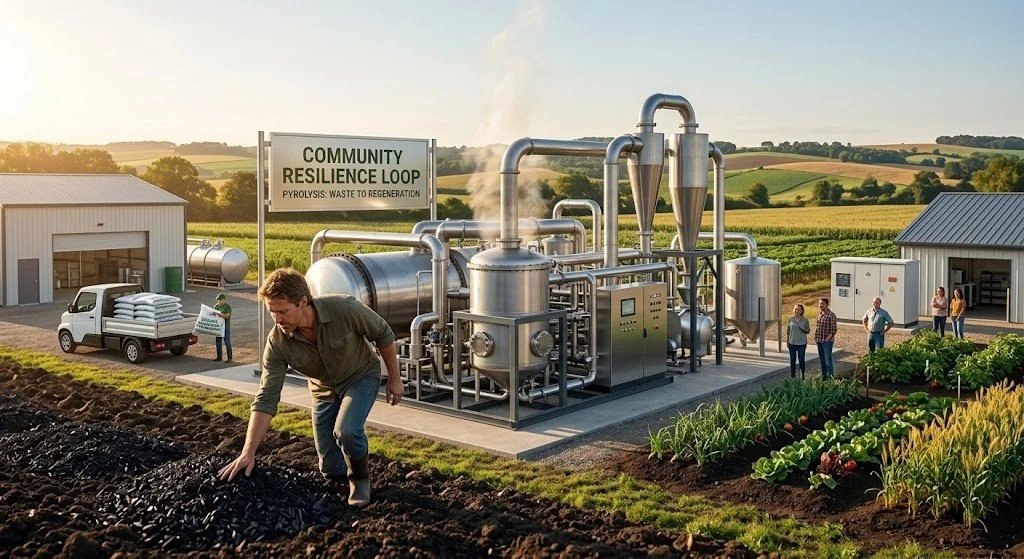
The Illusion of Compliance: Why the 10-Cent Recycling the-fee-is-the-lie,
very time you buy a bottle, you pay a 10-cent recycling fee—a micro-tax on a promise everyone knows is broken. When less than 10% of plastic actually gets recycled, compliance becomes theater. Discover why institutional trust collapsed, how Edo Japan solved the closed-loop puzzle centuries ago, and why thermal pyrolysis offers a real, proven molecular reset for local communities.
The Fee Is the Lie
We keep paying for a promise everyone knows is broken. The only honest answer is heat.
You pay the dime at the checkout. You sort the bin. You do your part.
And the bottle still ends up buried or burned overseas. The sludge still rides out to the field. The poison still comes back in the water, in the milk, in the blood.
That is not environmental policy. That is a fee on a promise everyone knows is broken.
We got very good at moving it
I didn't learn this from a study. I learned it from my own well. My household runs a whole-house filter now, because what comes out of the ground here can't be trusted straight from the tap.
A filter doesn't end PFAS. It catches it. The poison moves from the water into the filter media, and then the filter media becomes the problem — another waste stream, another thing to bury or burn. We are very good at moving PFAS around. We have no plan for ending it.
Same story everywhere you look. Twin Falls installs filtration. Mountain Home spends over $130 million — a pipeline and a treatment plant — not to fix its poisoned groundwater but to walk away from it and drink from somewhere else. Maine banned the spread, and California bans the chemical in the packaging while still land-applying its own sludge — over two million pounds of dry sludge every day.
Laws aim at tomorrow. Filters relocate today. None of it touches the molecule already out there.
The bond that won't break
PFAS are called forever chemicals for one reason: the carbon-fluorine bond. It is among the strongest bonds in all of chemistry. Nothing in nature breaks it — not sunlight, not microbes, not time. A treatment plant can't digest it. A filter can't unmake it. A statute can't repeal it.
There is exactly one force that breaks it: heat. Enough of it, applied right — sustained conversion at 700°C and up, with the off-gas captured and scrubbed — and the molecule doesn't get smaller or safer. It ceases to exist. Fluorine locked into inert mineral salts. Carbon into biochar. Chemists call it mineralization. Plain English: the poison dies.
This is pyrolysis — high-temperature conversion without oxygen. Not burning. Controlled: feed the waste in, hold the heat, and what comes out the other side is not a concentrated poison but biochar — stable carbon that rebuilds soil instead of poisoning it.
From flush to fork
Go back to the cycle: wastewater becomes bio waste. Right now the loop runs poisoned, because we spread the bio waste raw and the forever chemicals ride it all the way to the table.
Pyrolysis closes the loop the only way it can be closed: the poison dies in the middle. Wastewater becomes bio waste, bio waste goes through the heat, the PFAS is mineralized out of existence, and what reaches the farmland is clean biochar — carbon that holds water, holds nutrients, and holds nothing that will show up in a farmer's blood test ten years later.
From flush to fork, with the killing done in between.
Herald is the proving ground
Herald, California, 95638. An agricultural community of about 1,100 people, 35 percent of them seniors, many aging in place. A Cal Fire red zone with roughly 1,700 acres of eucalyptus on private land. Swales and vernal pools feeding an aquifer, impaired, with agricultural bio waste runoff compounding the damage.
One facility here answers two existential problems at once: the fuel load that burns our communities, and the poison already in the well. Woody biomass from fuel reduction gives the process the structural carbon and energy density that wet bio waste alone can't sustain. The same machine that mineralizes forever chemicals converts the fuel that threatens our homes into biochar.
The money is already being spent — nine figures to move PFAS around. A pyrolysis facility takes that same waste stream and ends it.
Stop paying for the promise
True circularity can't be purchased with a dime at the checkout. It's forged when a community takes ownership of its waste, transforms it locally, and reaps the rewards: energy from syngas, biochar rebuilding depleted soil, and a loop that finally closes.
Filters move it. Laws manage tomorrow. Only heat ends it.
Together we survive. Apart we burn.
The Unfiltered Loop | Part 2 of 5: The Indestructible Thread in Our Supply Chains
They don't break down. They accumulate. Every wash cycle sheds them, every treatment plant misses them — an indestructible thread running through your jacket, your water, your blood. It will outlive you.
You can't see them, but they're stitched into everything you touch.
Long before "forever chemicals" reach the municipal sludge we traced in Part 1, they're born in high-pressure industrial vats — engineered to repel water, resist heat, and outlive everything they touch. PFAS (per- and polyfluoroalkyl substances) run through global supply chains like an invisible, indestructible thread, coating our cookware, our carpets, our rain gear.
Every hot wash cycle on a stain-resistant jacket, every grease-proof wrapper breaking down in a landfill — each one sheds microscopic carbon-fluorine bonds. They slip past the grates, skimmers, and settling tanks of our treatment plants. They don't break down. They accumulate.
Manufacturers spent decades perfecting these compounds for durability, then handed cities the toxic fallout. Now the regulatory walls are closing in at the source. California is cutting the thread before it reaches the drain:
AB 1200: PFAS banned in plant-based food packaging; cookware makers must disclose what's in their coatings.
AB 1817: No new textiles or apparel with intentionally added PFAS — manufactured or sold.
AB 347: Stronger testing and enforcement across restricted products, so compliance isn't voluntary.
But severing the supply chain today doesn't touch what's already in the pipes. The chemicals in circulation are an industrial hangover — and source reduction alone won't cure it.
If this indestructible waste can't cycle through our water or settle into our soils, where does it go?
Next in Part 3: The Breaking Point — how Maine's L.D. 1911 land-spreading ban is forcing a national reckoning on where waste goes to die.
#Sustainability #PFAS #SupplyChain #WastewaterInfrastructure #CaliforniaLaw #TheUnfilteredLoop
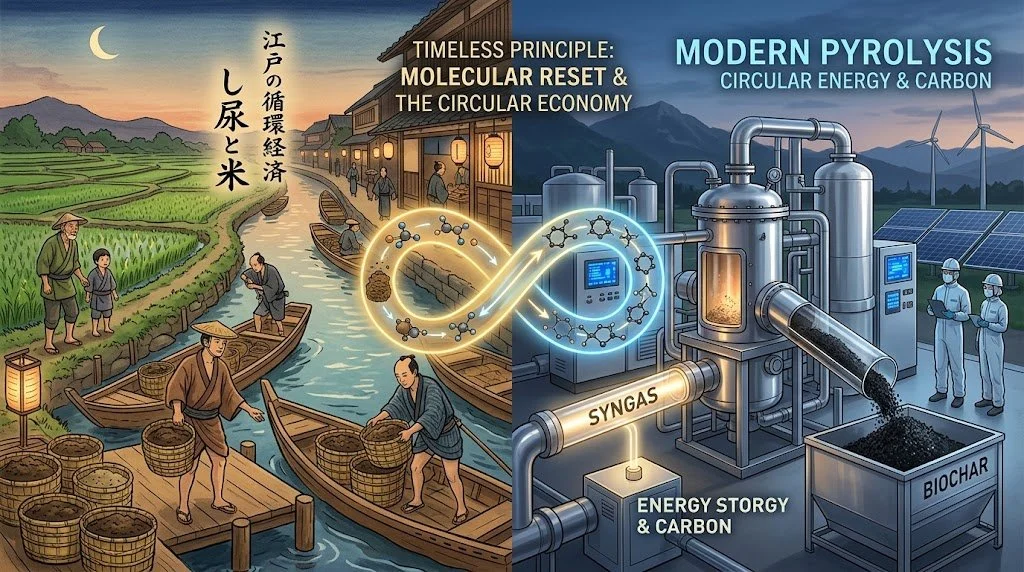
THE HISTORICAL GHOST
In 1750, Edo (Tokyo) supported one million residents with zero waste by pricing human waste as a valuable agricultural asset. Today, our attempts at circularity hit a wall of institutional cynicism and the psychological "yuck factor." Discover how historical night soil economics and modern thermal pyrolysis use pure physics to erase material history, destroy synthetic contaminants, and rebuild true local self-reliance.
Partner with Us. Grow with Us: The Golden Paradox Coupon Program
Golden Paradox Challenge — Game Description (Website‑Ready)
The Golden Paradox Challenge is a community game designed to turn everyday actions into meaningful fire‑resilience wins. Residents complete small missions — from home safety checks to neighborhood collaboration tasks — and earn Golden Paradox Coupons they can redeem at participating local businesses.
The game blends storytelling, humor, and real‑world impact. Each mission helps strengthen the “last mile” of wildfire prevention, while every coupon redeemed supports the local economy. It’s simple, fun, and built for all ages.
With the support of our $10,000/month Google Ad Grant, the Golden Paradox Challenge becomes a visibility engine for local partners. Every participating business is featured in targeted ads, highlighted in challenge missions, and promoted through creative content like our Burger Quest series.
This game isn’t just entertainment — it’s a community engagement platform that drives foot traffic, builds resilience, and connects residents with the businesses that support them.
The Herald Fire Prevention Council uses the $10,000 Google Ad Grant every single month to promote local businesses participating in the Golden Paradox Coupon Program. When you become a coupon partner, your restaurant, shop, or service gets featured in professionally managed ads that reach thousands of residents across Clay and the surrounding communities.
This isn’t just a coupon program — it’s a visibility engine.
Your business is showcased in targeted campaigns, highlighted in community challenges, and promoted through creative storytelling like our Burger Quest series. The Golden Paradox Challenge drives residents to explore, engage, and support local storefronts, and the Ad Grant ensures your offer gets seen.
Partner with Us. Grow with Us. Download the Coupon Partner Packet or apply online to join a network of businesses benefiting from $10K/month in sustained digital promotion.
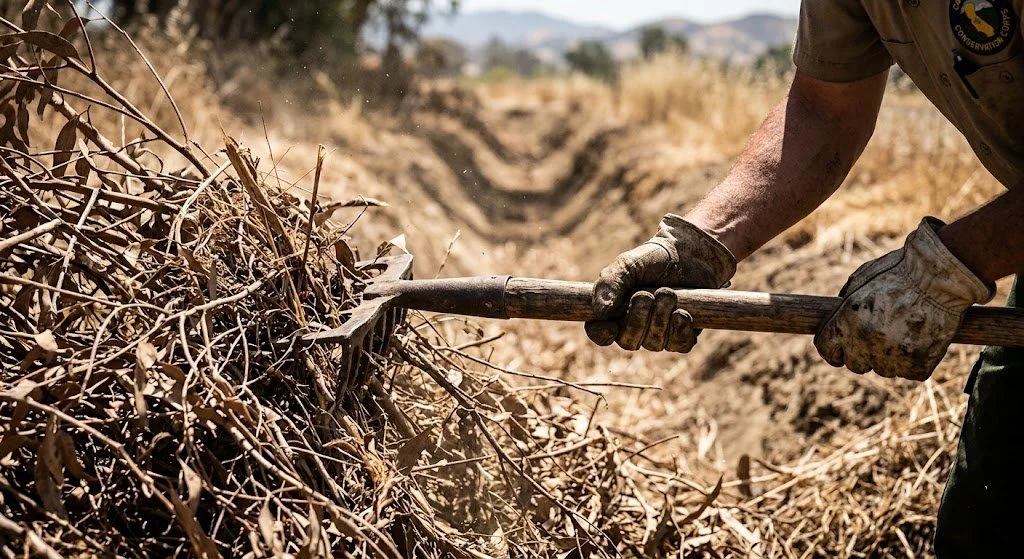
Core Mission Expansion: Managing Herald’s Hidden Fire Corridors
True fire resilience takes heavy lifting. Discover how we are clearing the hidden, overgrown fire corridors bypassing our defensible spaces, and how your support funds the last mile of fire defense.
At the Herald Fire Prevention Council (HFPC), we recognize that True Fire Resilience is achieved through a critical equation: Community (Prevention) + Agency (Response) = True Fire Resilience. Our mission to safeguard Herald, California, extends beyond individual property lines to address the interconnected environmental realities of our Wildland-Urban Interface (WUI).
The WUI Reality: When Vital Waterways Become Fuel Corridors
Herald’s landscape is defined by a natural network of drainage swales and vernal pools, particularly along corridors like Giusti Road and Clay Station Road. During the winter, these systems are vital for agricultural drainage and local aquifer recharge. However, in the dry summer months, they often become neglected afterthoughts.
As these swales dry out, they accumulate dense brush, overgrown weeds, and highly flammable debris from nearby eucalyptus groves. In a WUI environment, these neglected channels transform into high-speed fire fuses, capable of carrying wildfires directly through property lines and completely bypassing standard defensible space perimeters.
The Demographic Challenge: Protecting Our Aging Neighbors
Maintaining these deep, overgrown trenches requires heavy physical labor and specialized equipment. With seniors comprising approximately 35% of Herald's population, relying on individual homeowners to manually clear decades of entrenched agricultural holdovers is both physically and financially impossible. Fire prevention in our community cannot rely on isolated efforts; it demands a coordinated, neighborhood-level response.
The True Resilience Solution: Coordinated Defense
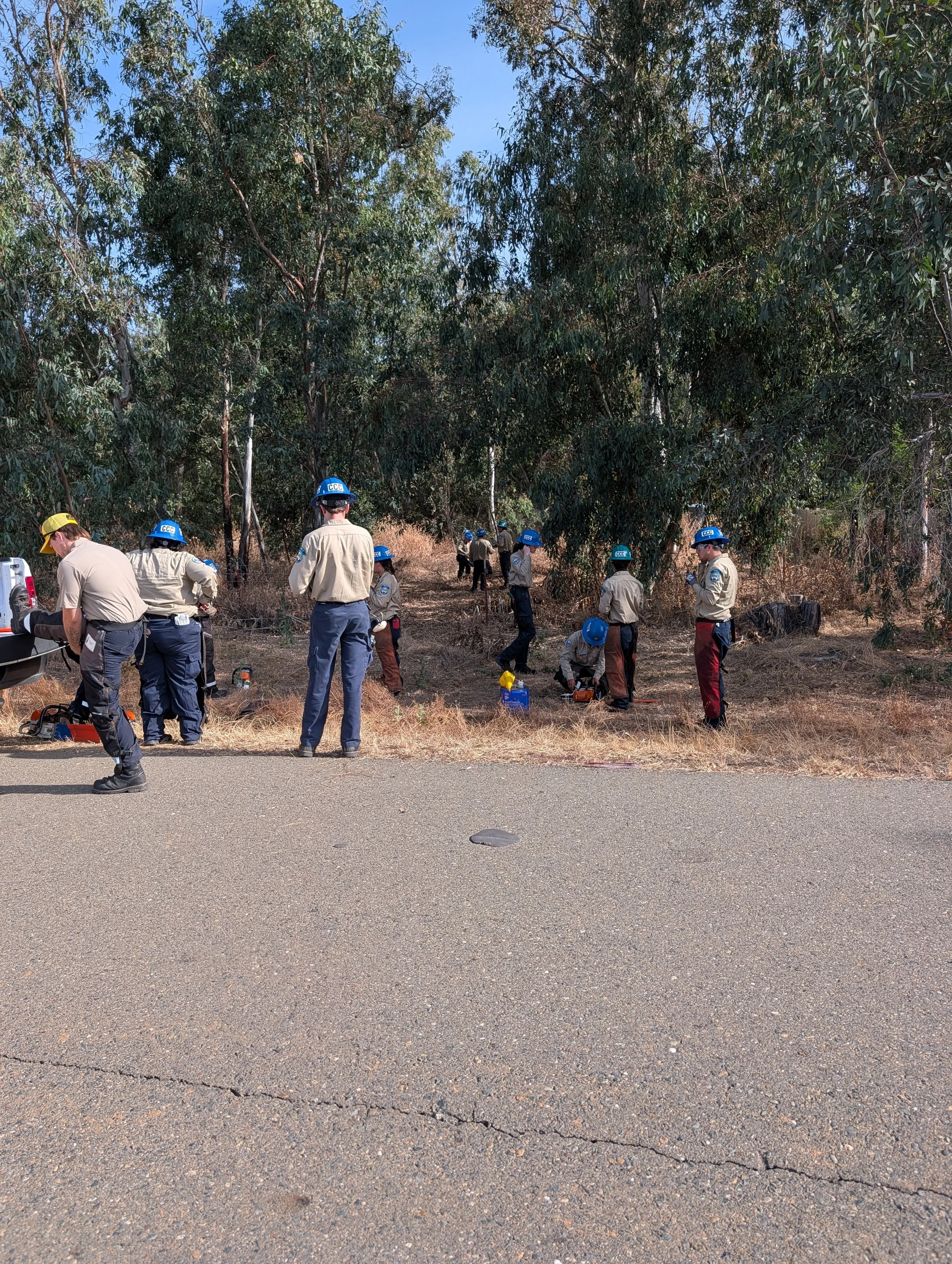
To bridge this gap, HFPC actively coordinates field mitigation projects with the California Conservation Corps (CCC). Our strategy focuses on heavy-lifting community defense:
Defensible Perimeters: Establishing robust 100-foot defensible space perimeters around vulnerable properties.
Swale Clearance: Systematically clearing connecting swale networks to eliminate high-speed fuel corridors.
Environmental Protection: Intercepting toxic post-fire leachate and biosolids runoff before it can contaminate local groundwater aquifers.
Funding the Last Mile: Merchant Partnerships & Individual Support
This critical infrastructure maintenance requires sustained backing to help Herald achieve and maintain long-term Firewise USA community status. Through The Golden Paradox Challenge ecosystem and our direct community outreach, we invite both local businesses and individual residents to become active participants in our safety infrastructure.
Local Merchant Partnerships For a subscription of just $20 a month, local businesses can become Coupon Partners. This program drives local foot traffic to participating storefronts while generating a steady funding stream for our field mitigation teams, creating a circular economy of community safety and economic support.
Individual Contributions Community advocates and residents can also make direct, tax-deductible donations to the Herald Fire Prevention Council, a registered 501(c)(3) nonprofit organization. Individual financial support directly funds the California Conservation Corps crews executing this heavy-lifting defense—ensuring that the physical burden of clearing decades of overgrown agricultural holdovers does not fall on our aging neighbors.
Whether through a monthly merchant sponsorship or a personal donation, your investment directly funds the last mile of fire defense, protecting our local groundwater and securing our neighborhood's resilience.
Transforming Subsurface Wildfire Risk into Clean Regional Power: The Case for Biomass Pyrolysis in Sacramento County’s Agricultural & Wildland Interface
Transforming Subsurface Wildfire Risk into Clean Regional Power: The Case for Biomass Pyrolysis in Sacramento County’s Agricultural & Wildland Interface
Executive Overview
California’s wildfire crisis is typically framed around overgrown forests, severe drought, and climate extremes. However, a critical and overlooked fuel problem exists in agricultural and rural Wildland-Urban Interface (WUI) zones: the continuous land application of treated municipal sludge, commercial biowaste, and unrefined green waste, a practice broadly regulated under CalRecycle Organic Waste Management Standards and regional water quality board permits.
Marketed as beneficial soil amendment, millions of tons of this material are spread and tilled into pasture ground across California annually. Because standard mechanical screening cannot capture all synthetic film plastics and micro-packaging, decades of tilling have created dense, petroleum-rich, hydrophobic fuel beds beneath the surface. When ignited, routine flashy grass fires turn into deep-seated subterranean smoldering events that resist water penetration, emit toxic VOCs, and exhaust the fragile staffing models of rural fire protection districts.
To protect regional grid infrastructure and advance clean energy mandates, the Sacramento Municipal Utility District (SMUD) 2030 Zero Carbon Plan and regional policymakers must transition away from open-land spreading. Investing in regional biomass pyrolysis infrastructure—supported by research on biochar carbon sequestration from the USDA Agricultural Research Service (ARS)—permanently removes hazardous fuel from the landscape, safely neutralizes synthetic contaminants and PFAS, generates firm zero-carbon dispatchable power, and yields stable, moisture-retentive biochar.
Transforming Subsurface Wildfire Risk into Clean Regional Power
The Case for Biomass Pyrolysis in Sacramento County’s Agricultural & Wildland Interface
Executive Overview
California’s wildfire crisis is typically framed around overgrown forests, severe drought, and climate extremes. However, a critical and overlooked fuel problem exists in agricultural and rural Wildland-Urban Interface (WUI) zones: the continuous land application of treated municipal sludge, commercial biowaste, and unrefined green waste.
Marketed as beneficial soil amendment, millions of tons of this material are spread and tilled into pasture ground across California annually under standard permits. Because standard mechanical screening cannot capture all synthetic film plastics and micro-packaging, decades of tilling have created dense, petroleum-rich, hydrophobic fuel beds beneath the surface. When ignited, routine flashy grass fires turn into deep-seated subterranean smoldering events that resist water penetration, emit toxic VOCs, and exhaust the fragile staffing models of rural fire districts.
To protect regional grid infrastructure and advance clean energy mandates, the Sacramento Municipal Utility District (SMUD) and regional policymakers must transition away from open-land spreading. Investing in regional biomass pyrolysis infrastructure permanently removes hazardous fuel from the landscape, safely neutralizes synthetic contaminants and PFAS, generates firm zero-carbon dispatchable power, and yields stable, moisture-retentive biochar.
The Operational Reality: A Rotating Roster on the Frontlines
The operational strain of these fires cannot be understood without examining who actually staffs rural fire engines.
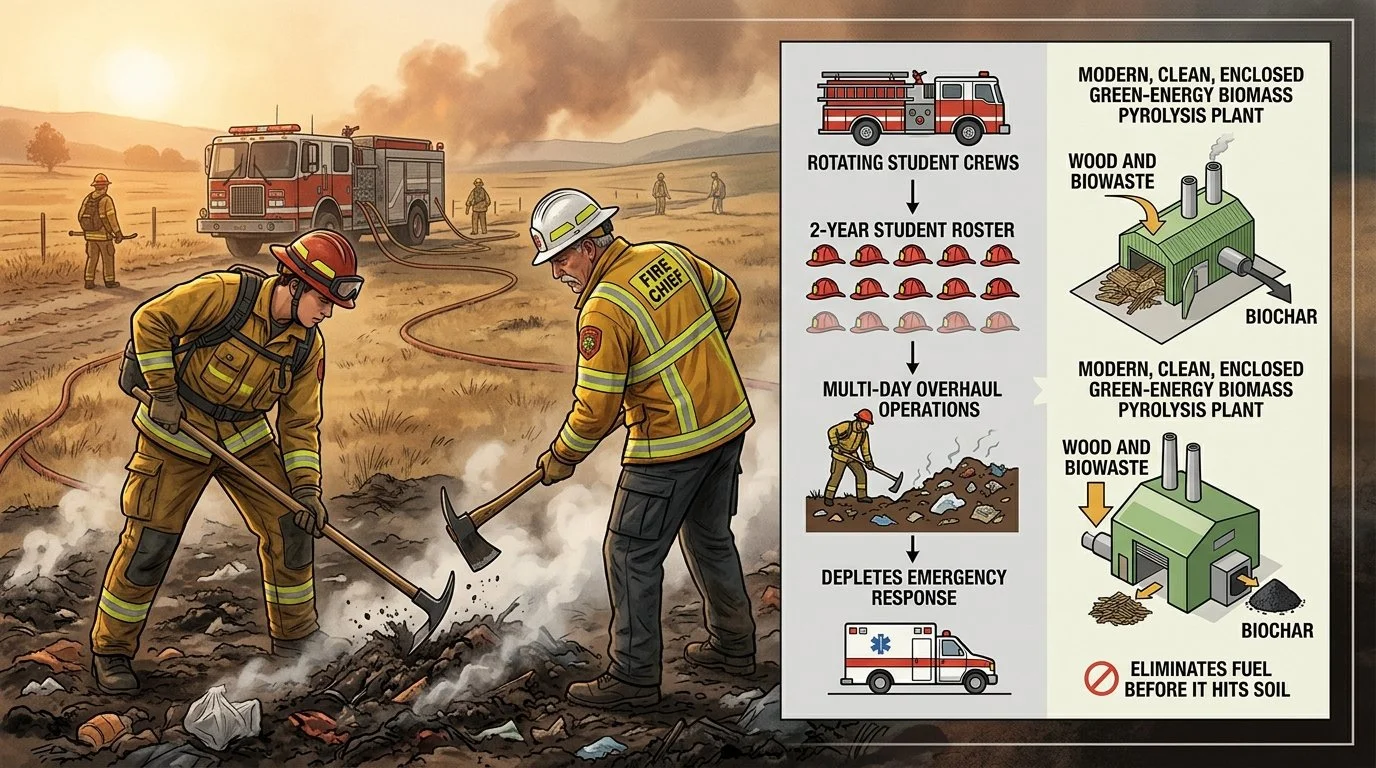
Rural fire districts do not operate with deep benches of seasoned career personnel. Instead, suppression relies heavily on 18- to 20-year-old student firefighters—young recruits learning the trade, earning their certifications, and serving on rapid two-year rotations before being hired by full-time municipal or state agencies across California.
Holding this entire system together is typically a skeleton leadership core: a retired Chief and Assistant Chief, or perhaps three senior officers if the district is fortunate.
Managing an inexperienced, constantly cycling crew is demanding under normal conditions. Throwing them into a multi-day subsurface muck and plastic fire creates an unsustainable operational crisis:
Protracted Physical Exhaustion: An initial attack on flashy annual grass is straightforward training for a young crew. Smoldering underground plastic mats, however, turn into days of punishing, multi-shift overhaul where young firefighters must wield hand tools, drag hose lines through toxic mud, and baby-sit containment lines around the clock.
Depleted Mutual Aid & Training Gaps: When a small volunteer/combination department is tied up for 72 hours discing and soaking a single ranch pasture, district coverage collapses. Basic medical and structural response across the coverage zone is compromised, and the constant turnover means new recruits are repeatedly thrown into high-hazard overhaul environments with minimal institutional memory.
The Firefighter’s Physics: When Soil Amendment Becomes Subsurface Fuel
When pasture ground is heavily amended with tilled biowaste and synthetic residues, standard rangeland fire physics break down:
Petroleum-Dense Fuel Beds: Plastics (polyethylene, polypropylene) carry an energy density of $40\text{--}45\text{ MJ/kg}$, compared to just $15\text{--}18\text{ MJ/kg}$ for dry cellulose grass. Tilling these synthetic fragments 6 to 12 inches into topsoil embeds a high-Btu fuel matrix directly underground.
The "Smoldering Candle" Mechanism: Under extreme heat, buried plastics melt and fuse with organic fines, creating a dense, waxy subterranean crust. This layer restricts oxygen, traps heat, and allows fire to smolder out of sight for days.
Severe Water Repellency & Resource Exhaustion: Melting synthetic matrices induce extreme soil hydrophobicity; standard hose line applications bead up and run off the crust. Extinguishing these fires requires heavy equipment—such as bulldozers and deep-ripping tractors—to churn the earth while water tenders apply tens of thousands of gallons per acre.
Traditional Land Application vs. Advanced Pyrolysis
Continuing to permit raw biowaste spreading simply shifts combustible waste from urban centers onto rural rangelands. Pyrolysis offers a closed-loop, engineered alternative.
Traditional Land Spreading vs. Regional Biomass Pyrolysis
Combustion Hazard:
❌ Traditional: Creates dense, smoldering subterranean fuel beds.
✅ Pyrolysis: Produces non-combustible, inert biochar.
Synthetic Debris:
❌ Traditional: Leaves shredded film plastics & microplastics in soil.
✅ Pyrolysis: Thermally destroys plastics & complex polymers.
Chemical Contaminants:
❌ Traditional: Cycles PFAS and industrial compounds into soil/water.
✅ Pyrolysis: High-heat reactor breaks carbon-fluorine bonds.
Rural Crew Impact:
❌ Traditional: Multi-day overhaul drains 2-year rotating student crews.
✅ Pyrolysis: Rapid mop-up; protects district operational capacity.
Energy Generation:
❌ Traditional: None (wasted latent thermal energy).
✅ Pyrolysis: Produces clean syngas and firm, dispatchable power.
Carbon Lifecycle:
❌ Traditional: Slow anaerobic decay releasing fugitive emissions.
✅ Pyrolysis: Permanent, verifiable carbon dioxide removal (CDR).
The Strategic Alignment for SMUD
Integrating regional biomass pyrolysis directly supports SMUD’s ambitious clean energy goals and operational resilience mandates:
1. Firm, Dispatchable Zero-Carbon Power
As SMUD expands solar and battery energy storage across rural service territories, biomass pyrolysis provides predictable, non-intermittent baseload and dispatchable energy that does not depend on daylight or wind conditions.
2. Direct Utility Asset & Substation Protection
Establishing regional off-take facilities incentivizes rapid fuel reduction along transmission corridors, distribution lines, and rural substations. Removing hazardous woody biomass and agricultural waste reduces the thermal intensity of wildland fires near critical electrical infrastructure.
3. Alignment with 2030 Zero Carbon Plan
The solid by-product of pyrolysis—pure biochar—sequesters carbon in a stable elemental form for centuries, generating high-integrity Carbon Dioxide Removal (CDR) attributes that support utility decarbonization targets.
4. Agricultural & Watershed Co-Benefits
Returned to local farmland, clean biochar acts as a natural sponge, improving soil water retention and nutrient efficiency without the fire risks or synthetic contamination associated with unpyrolyzed sludge.
The Call to Action
Wildfire resilience is not solely an issue of forest thinning or vegetation clearing—it is a waste management, soil physics, and frontline human staffing challenge.
Continuing to till synthetic-laden biowaste into local rangelands creates an unacceptable, artificial fire burden on rural communities and the young student firefighters working to protect them. The Herald Fire Prevention Council calls on SMUD leadership, regional regulators, and local governance to prioritize a Regional Biomass Pyrolysis Pilot Facility to eliminate combustible biowaste, safeguard the electrical grid, and deliver clean, reliable power to Sacramento County.
To review our ongoing regional fire mitigation efforts and participate in the community discussion, visit the Herald Fire Prevention Council on LinkedIn.

Audio Analysis (Fuel Mitigation + Vendor/Coupon Sponsor Focus
Audio Analysis (Fuel Mitigation + Vendor/Coupon Sponsor Focus)
This 24‑minute audio briefing explores how the Blueprint to Resilience game connects directly to fuel‑mitigation priorities while opening a new, community‑driven funding pathway for prevention work. The analysis breaks down how gameplay teaches residents to recognize hazards, understand mitigation strategies, and engage with local vendors who participate as coupon sponsors.
For vendors, service providers, and potential coupon partners, this audio explains how the Blueprint model creates measurable value: increased visibility, deeper community engagement, and a funding platform that ties local business support to real‑world prevention behaviors. It’s an informative look at how gamification can strengthen mitigation efforts while building a sustainable economic loop that benefits both residents and local partners.
The Fire Resilience Equation: Why Corporate ESG is Missing the "Last Mile" of Prevention
🚒 Community (Prevention) + Agency (Response) = True Fire Resilience.
We all see the massive fire trucks and air tankers when a crisis hits. That response work is heroic. But true safety means making sure the fire never takes hold in the first place—and that starts at the "last mile," right in our own backyards.
Thanks to our amazing mission partner Shuru, who lent us a game designer pro-bono, the Herald Fire Prevention Council has locked down this last mile with The Golden Paradox Challenge! It’s a gamified behavioral simulation built to train neighborhoods in proactive safety.
Even better, we’ve built a self-sustaining local loop: 🛒 Local Merchants pay a small $20/month fee to give weekly $100 reward coupons to players who clear safety tasks (boosted by our $10k/month Google Ad Grant!). 🏡 100% of those merchant fees go directly into a fund to clear acres of defensible space for our local seniors, who make up 29% of our community.
This simulation is like a child with an unlimited future. The foundation is built right here in Herald, and now we are officially looking for a global Anchor Mission Partner (think tech, telecom, or insurance giants) to help us scale it worldwide across multi-disaster modules and next-gen graphics.
We are ready to move beyond just managing disasters and start actively preventing them. Check out our updated page to see how the game works or to get involved as a partner!
#FirePrevention #HeraldCA #CommunityResilience #TheGoldenParadox #SupportOurSeniors
Corporate disaster response is world-class, but prevention remains a multi-billion-dollar blind spot. To achieve true resilience, we must bridge the "Last Mile"—the critical gap between agency response and community-led prevention.
Every year, infrastructure and utility giants showcase incredible engineering in the wake of climate disasters. We see "cells-on-wheels" and mobile command centers deployed within hours. While this work is heroic and vital, our disaster portfolios are filled with exotic response tools while our prevention portfolios remain almost entirely empty.
But as someone who has stood on both sides of the line—first as a volunteer fireman and now leading fire resilience initiatives—I see a glaring, multi-billion-dollar blind spot in the corporate landscape. Our disaster response portfolios are filled with exotic toys, while our prevention portfolios are almost entirely empty.
To fix this, we need to look at disaster safety through a simple, mathematically sound formula:
$$\text{Community (Prevention)} + \text{Agency (Response)} = \text{True Resilience}$$
The Response-Heavy Imbalance
Right now, the equation is entirely lopsided. Billions of dollars flow into the Agency (Response) side. Governments, utilities, and telecom giants excel at reactive measures. When an emergency strikes, they deploy assets, save the day, and document the impact.
But relying solely on response is a dangerous paradox. It means waiting for communities to face devastation before corporate capability can be demonstrated.
True resilience isn't just about how fast we can rebuild a cell tower or deploy a logistics network after the smoke clears. True resilience requires the other half of the equation: Community (Prevention).
Locking Down the Last Mile
In emergency services, we know that the most critical, hardest-to-reach zone is "the last mile"—the actual behavior, awareness, and preparation of individual people in their own neighborhoods before a crisis hits.
Agencies can dump retardant from planes and clear main roads, but if the local community hasn't altered its daily behaviors and local mitigation habits, the chain breaks.
At the Herald Fire Prevention Council, we have a lock on the last mile of fire prevention.
Four and a half months ago, tech innovator Shuru stepped up as a mission partner, embedding a game designer with us to build out our vision. The result is The Golden Paradox Challenge—a gamified behavioral simulation software designed to build fire-resilient communities before crisis strikes.
We didn't just build a simulator; we built a self-sustaining micro-economy:
The Local Merchant Engine: Local businesses pay a $20/month fee to provide reward coupons to players who complete safety tasks.
The Marketing Amplifier: Businesses gain exposure through our $10,000/month Google Ad Grant.
The Grassroots Impact: 100% of fees fund defensible space clearing for seniors, who make up 29% of our demographic.
The Horizon: An Unlimited Future for Global All-Hazards Scaling
Right now, the simulation is a child with an unlimited future. The foundation is rock solid, but the architecture is built to expand infinitely with the right anchor partners.
As we scale beyond our initial WUI focus, the roadmap for the platform includes:
Multi-Disaster Modules: The core behavioral engine can easily transition to simulate hurricane readiness, flood mitigation, earthquakes, and urban grid failures.
Robust Next-Gen Graphics: Upgrading the visual engine to immersive, high-fidelity 3D modeling to make localized neighborhood risks starkly realistic.
Advanced Back-End Data Gathering: Transforming user interactions into predictive behavioral data, mapping out precisely which pockets of a city or county are highly prepared versus which areas are lagging in real-time.
Hyper-Targeted Safety Deployments: Giving agencies and corporate partners the exact geographic targeting indicators they need to deploy physical resources, community grants, and mitigation efforts efficiently before a disaster strikes.
A Global Call for an Anchor Mission Partner
We have secured the technology, verified the loop, and locked down the last mile strategy. Now, we are looking for the right visionary to help us guide and scale it globally.
We are opening conversations to secure a single, global Anchor Mission Partner for the Golden Paradox Challenge.
This opportunity is built specifically for organizations that already possess a massive footprint in disaster recovery and response—whether in telecommunications, large-scale housing, utilities, or insurance.
By stepping into the exclusive founding anchor position, your organization won't just be reacting to the next crisis. You will perfectly balance the resilience equation. You will pair your world-class response with an equally world-class, global prevention initiative that solves the last mile problem.
The net is cast globally. The software is ready.
If your company is ready to move beyond managing disasters and start actively preventing them, let’s connect to build a safer future together.
#FirePrevention #CorporateSocialResponsibility #ESG #DisasterResponse #Innovation #TheGoldenParadox #FireResilience #CivicTech #DataIntelligence
Contact the Herald Fire Prevention Council at info@heraldfirecouncil.org to discuss partnership opportunities.
Project Genesis: Building a Fire-Resilient Herald
COMMUNITY (prevention)+AGENCY (response)=RESILIENCE
Community (Prevention) + Agency (Response) = Resilience.
The Silent Threat
Living in Herald means embracing independence. But in a WUI red flag zone surrounded by 1,700 acres of eucalyptus, isolation can quickly become a trap. While dry brush and high winds are visible dangers, our community's true vulnerabilities are often much quieter: Apathy, Distrust, and Procrastination.
Changing the Narrative
The Herald Fire Prevention Council is proud to introduce Project Genesis, an animated series that reimagines wildfire prevention.
Watch as the personified shadows of Apathy and Distrust try to use our 100-foot driveways and rural fences to keep us disconnected. Enter our hero, "The Conduit"—representing calm, methodical, neighborly action. Project Genesis proves that we don't need to fight the entire battle overnight; we just need to build our defenses one driveway at a time.
Step Up to the Golden Paradox Challenge
Project Genesis is your visual introduction to the Golden Paradox Challenge. We have developed a unique behavioral simulator to help our 1,200 residents build real-world fire resilience. By testing your readiness and building positive habits, you can earn exclusive rewards from our local Anchor Partners.
The battle against the flames begins long before the smoke appears. It begins with a single conversation.
Are you ready to step up and anchor your quadrant?
[ Button: Join the Circuit & Take the Challenge ] (Link to: heraldfirecouncil.org/fire-line)
Would you like me to generate the video for the final panel of Page 3 to complete this first sequence, or would you like to draft the B2B pitch for recruiting your $20/month coupon partners?

Understanding: The Golden Paradox Challenge
The Next Level of Resilience: An Invitation to Partner
Fire prevention has traditionally been a message of "don'ts"—don't leave the stove on, don't clear brush late in the day. At the Herald Fire Prevention Council, we’re flipping the script. We’ve turned preparation into a proactive, engaging experience through the GPC Game.
We have proven that when you gamify safety, engagement skyrockets. But to move beyond our borders and protect more communities, we need more than just players—we need partners.
Ready to change the face of fire prevention? We’re looking for partners to help us scale the GPC Game and bring vital safety education to new heights. Watch the video to learn about our mission, our progress, and how you can get involved in this unique community project.
#GPCGame #ScaleForImpact #InnovationInSafety #EdTech #HeraldFirePrevention #CommunityResilience #SafetyFirst #PublicPrivatePartnership #HeraldCA #CollaborateForSafety #SafetyInnovation #FutureOfPrevention
Small Actions. Big Impact.
When the fire comes, it tests more than just our response—it tests our preparation. This video highlights the partnership between the Herald Fire District and our community. We hold our end of the bargain by staying vigilant and prepared, so they can hold theirs when it matters most. Every small action you take today is a step toward a safer tomorrow for all of Herald. #HeraldCA #HeraldFireDistrict #HFPC #HeraldStrong #SacramentoCounty #FirePreparedness #SmallActionsBigImpact #WildfireSafety #HomeSafety #FirstResponders #VolunteerFirefighters #CommunityResilience
We Prepare, They train
Fire doesn’t choose a path, but we choose our actions. This short clip highlights the essential partnership between the Herald Fire Prevention Council and the community. While our firefighters are putting in the hours to sharpen their skills, it's up to us to ensure our homes and properties are prepared. It’s more than a safety measure—it’s the deal we make to keep Herald safe. #HeraldCA #HeraldFire #CommunitySafety #FirePrevention #EmergencyPreparedness #TheDeal #WePrepareTheyTrain #FireReady #SafeHerald
Introducing the Golden Paradox Challenge
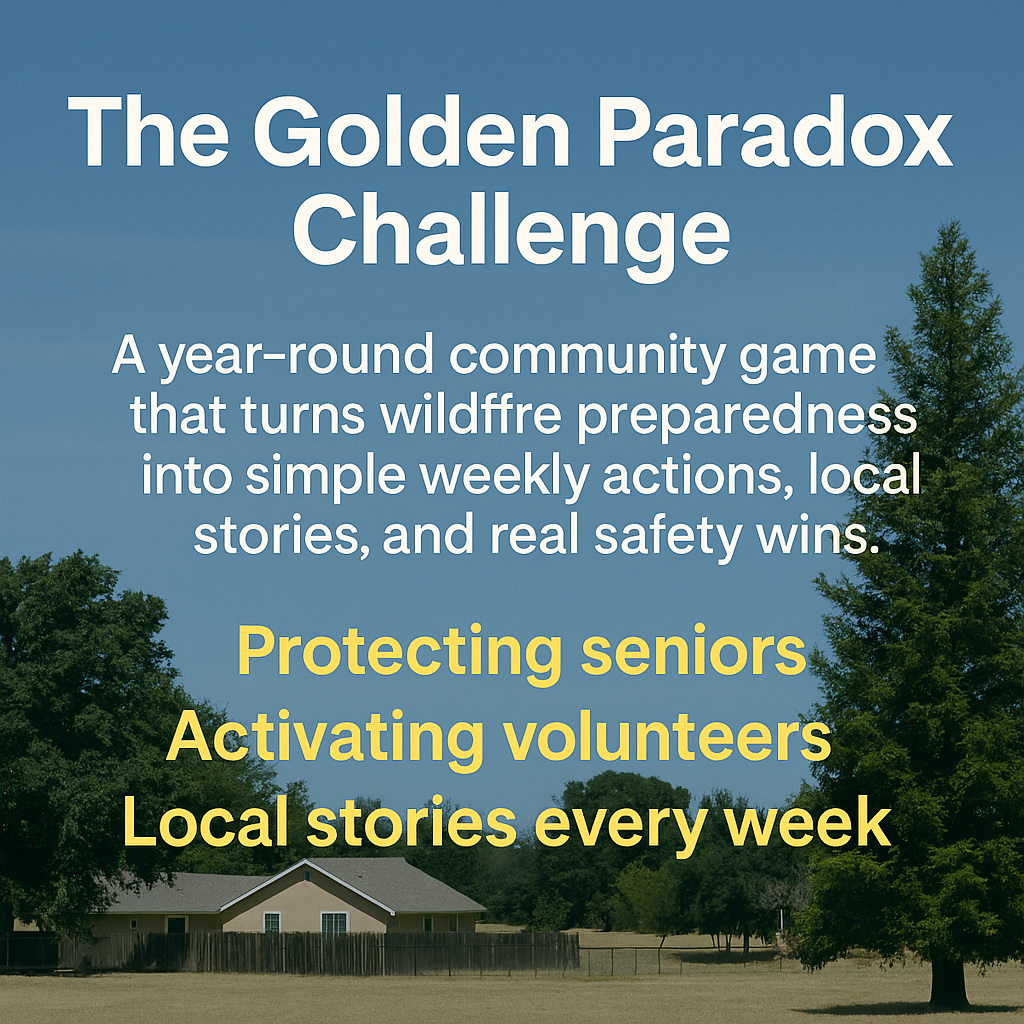
Today, I’m sharing the first look at something we’ve been building for our community — the Golden Paradox Challenge. It’s a year‑round game that turns wildfire preparedness into simple weekly actions, local stories, and real safety wins for the people who need it most.
This first video introduces the vision behind the Challenge and how it will help protect seniors, activate volunteers, and strengthen rural communities one week at a time. We’re now inviting mission‑aligned partners to help us bring this model to scale.
#WildfireResilience #CommunitySafety #RuralCommunities #SeniorsFirst #VolunteerPower #NonprofitLeadership #CivicTech #CommunityImpact #GoldenParadoxChallenge #WildfirePreparedness
The Golden Paradox Challenge is a year‑round community game that turns wildfire preparedness into simple weekly actions, local stories, and real safety wins. Built in Herald, California, the Challenge helps neighbors protect seniors, strengthen volunteer networks, and build resilience from the ground up.
Each week, residents complete small, achievable tasks — from clearing defensible space to checking smoke alarms — and share their progress through community stories. These weekly actions add up to something powerful: safer homes, stronger connections, and a community that’s ready before disaster strikes.
The Golden Paradox Challenge is designed to scale across rural California, offering a model that blends civic engagement, wildfire education, and community pride. We’re inviting mission‑aligned partners to join us as we expand this work and create positive, local impact every single week.
The Fire Line: Innovation & Safety Updates
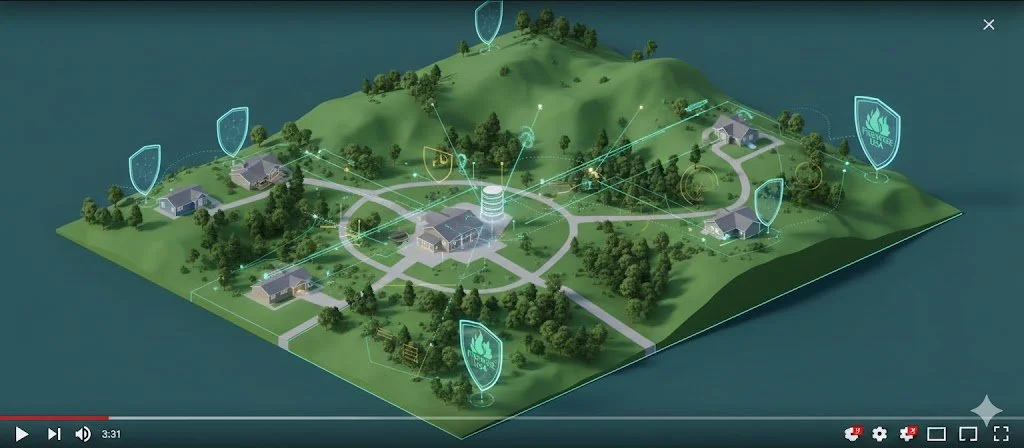
Welcome to the Fire Line, our digital hub for the latest in wildfire technology and community safety. Here, our expert contributors share insights on everything from robotics in fire prevention to local preparedness training.
The Architecture of Engagement: The Build
Building the technical engine that turns WUI community resilience into a scalable, high-engagement reality.
The Architecture of Engagement: The Build
The core of our mission is solving the "preparedness problem" by transforming unglamorous civic tasks into a rewarding, high-engagement gameplay loop.
Our Technical Roadmap Includes:
The Gameplay Loop: Architecting a system where short, real-world preparedness actions translate into in-game points and progress.
Competitive Infrastructure: Building robust, scalable leaderboards that allow neighbors and communities to compete in real-time.
Merchant Integration: Developing a secure bridge to local businesses to deliver real-world prizes and coupons to top-performing players.
Data For Good: Creating a platform that generates actionable data to help communities achieve Firewise USA certification.
We are currently backed by a $10,000/month Google Ad Grant to drive user acquisition and visibility once the platform is live.
What we need now is the engine. We are looking for a dev shop or technical lead who wants to build a scalable model of resilience that can be deployed to any community.
#TechPartnership #GameDev #SoftwareEngineering #GoldenParadox #Innovation #CivicTech #CommunityResilience #ArchitectureOfEngagement

The beginning part 1
Can I pull this off? Let me know your predictions in the comments! 👇
#GoldenParadoxChallenge #TheBeginning #Part1 #Gaming #YouTubeShorts #NewChallenge
The journey begins today. 🚀 I’m officially starting the Golden Paradox Challenge and I have no idea what I’ve just signed up for!
This is Part 1 of the series. Watch as I take my first steps into the challenge and try to set the pace for what's to come. It’s going to be a wild ride, so make sure you’re subscribed to see if I can actually make it to the end!
Can I pull this off? Let me know your predictions in the comments! 👇
#GoldenParadoxChallenge #TheBeginning #Part1 #Gaming #YouTubeShorts #NewChallenge

THE AWAKENING
I have no idea what I just signed up for. My hands are literally shaking. This is day one of the Golden Paradox, and I’m already questioning my life choices. Let’s get into it
The journey begins here.
Welcome to the premiere of The Awakening, the first chapter in the Golden Paradox series. In this opening sequence, we find Doctor Strange and a mysterious Lycan ally standing at the threshold of the Golden Gate—the entry point to a fragmented multiverse of floating diorama worlds.
The Mission
While the visual quest is to recover lost artifacts and stabilize the paradox, the deeper story is about us. This video marks the start of our collective journey toward becoming a Firewise Community.
The Ultimate Paradox
We face a challenge that affects every neighbor: To protect our sanctuary, we must transform our landscape. The paradox lies in the fact that our individual actions behind our own "gates" determine the survival of the entire community.
What to Expect in This Series:
The Science of Safety: Like the Master of the Mystic Arts, we use strategy and foresight to create defensible space.
The Power of Nature: We learn to respect and work alongside the wild environment we call home.
Community Resilience: Discover how one "diorama" (home) being prepared strengthens the entire neighborhood chain.
The gate is open. The paradox is set. It’s time for the community to awaken.
#GoldenParadox #Firewise #TheAwakening #CommunitySafety #DoctorStrange #DefensibleSpace
Challenge for today: Look at your "diorama" (your property). What is one small step you can take this week to create a fire-safe zone? Is it clearing gutters? Thinning brush? Moving woodpiles?
👇 Share your first step in the comments below. Let’s solve this paradox together! #Firewise #GoldenParadoxChallenge
The Golden Paradox Challenge: Building Fire-Safe Communities Through Play (audio)
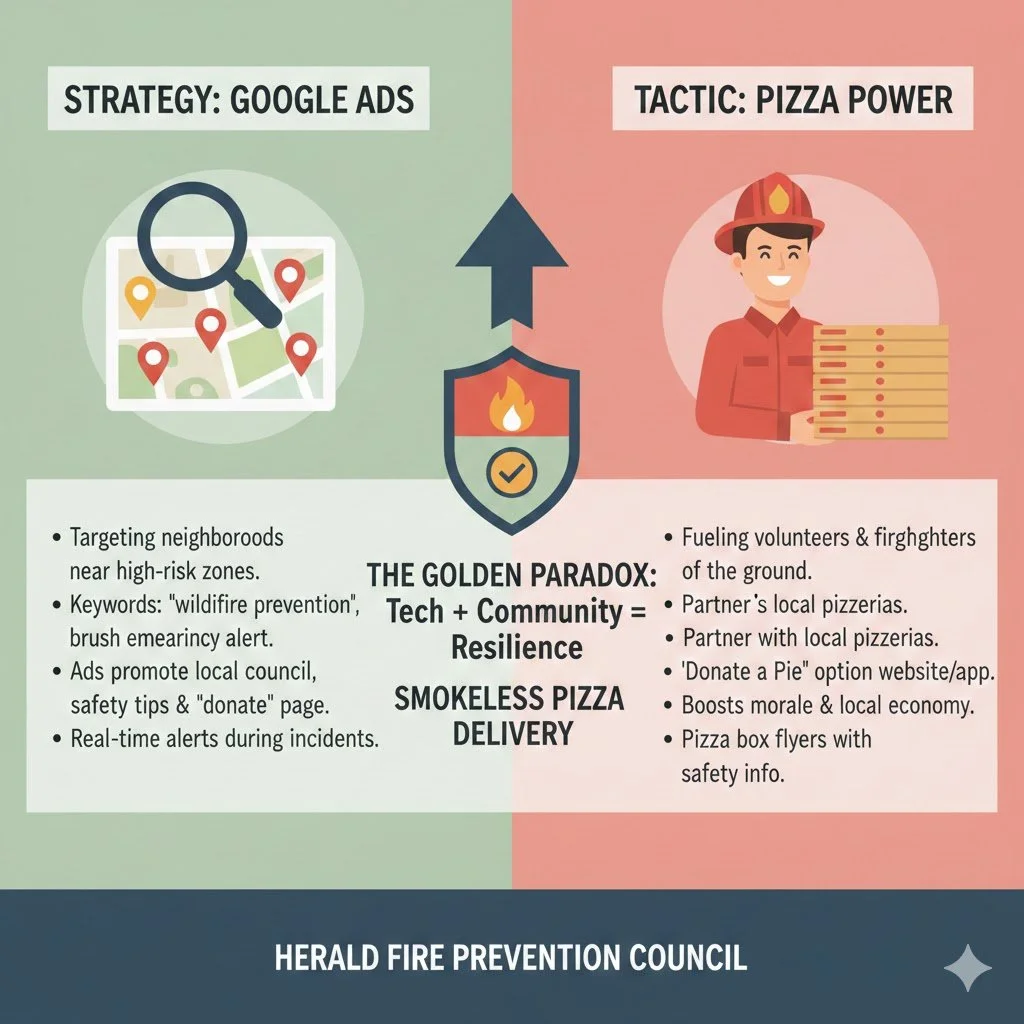
Step 1: Optimize the ads. Step 2: Open the pizza box. Step 3: Survive the paradox. If the algorithm doesn’t get me, the pepperoni will. Let’s go.
Strategy meets Tactic: How we're leveraging Google Ads and local 'Pizza Power' to solve the Impossible Equation of rural fire safety
What if the most beautiful thing about where you live is also the most dangerous? And what if a video game could save your neighborhood?
Northern California's golden hills are stunning every summer - and they're also 1,700 acres of wildfire fuel waiting to ignite. Herald Fire Prevention Council took $3,000 in startup funding and turned it into $120,000 in annual capacity by doing something nobody expected: we built a game that makes fire safety engaging, partnered with local restaurants and businesses to provide prizes, and leveraged $10,000 per month in free Google advertising to create a self-sustaining platform that could protect communities across California.
This is the story of how a small rural nonprofit is using paradoxes, psychology, and smart partnerships to solve a problem that billions in firefighting budgets haven't fixed.